
Reviews 6 min read
Hyundai INSTER review: The surprisingly brilliant budget EV
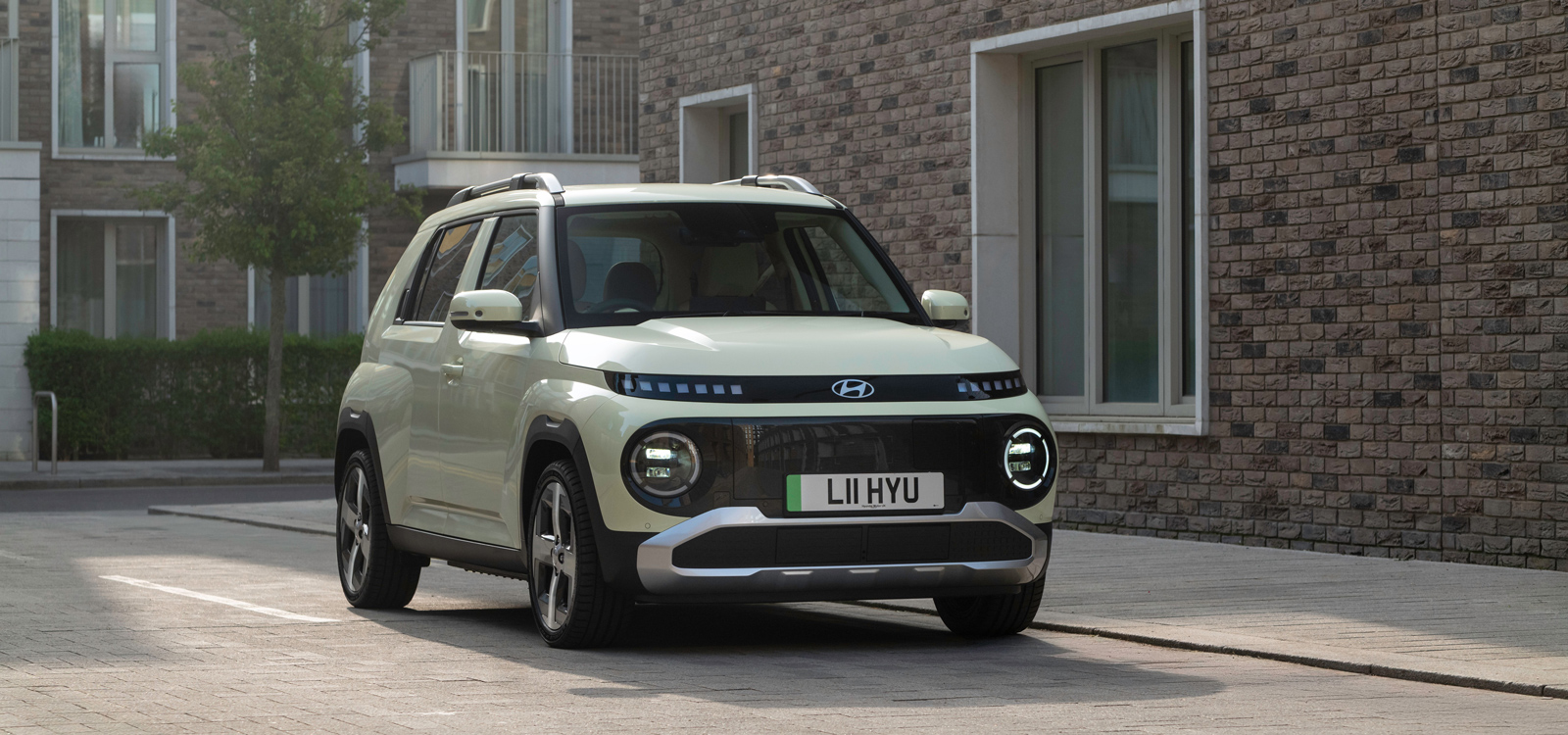
This is the Hyundai INSTER and despite the awful name – designed to appeal to Gen z social media twats – it’s a brilliant little car. I have taken the kids to school in it, done a week’s shop and braved a weekend away to the Isle of Wight – and I have no complaints. This little EV is absolutely brilliant.
Discover EV expert verdict...

4.5 / 5
- Excellent real-world range and efficiency
- Exceptionally practical for its size
- Comfortable, refined and fun to drive
- Only seats four
- Interior materials let it down slightly
- More expensive compared to rivals
Overview
The INSTER is Hyundai’s new city EV with a segment leading range of up to 229 miles (I was getting around 212 every time I juiced up), it has a spacious and versatile interior, quirky looks and it’s a joy to drive. And the best thing is it’s priced from £23,505 for the entry-level 01, although I appreciate there are cheaper rivals.

Driving
Both models are powered by a single motor that delivers 96bhp in the base variant and 113bhp in the long range car and both versions offer 108lb-ft of torque. It sounds terribly slow and it is if you look at the 0-62 times, but it only weighs between 1300 and 1400kg depending on the variant, so it feels really zippy and in Sport mode you’ve got enough grunt for a B-road overtake.
In fact, it really impressed me with how smooth the power delivery was – it was also grippy and the steering was pretty responsive and nicely weighted, body roll relatively well contained, the suspension allowed it to ride over bumps and potholes without thumping through the cabin, and there was little noise levels inside the cabin even at motorway speeds. And that’s because Hyundai spent a lot of time in this area, reinforcing the floor members, double-sealing the door systems and fitting a full underbody cover. The adaptive cruise and lane centering system worked really well too.
There are five levels of brake recuperation. Three standard modes that can be adjusted using the steering wheel paddles, including a handy auto-regen level which slows the INSTER down more if the car in front of you starts to slow, a one-pedal driving mode called i-Pedal and an option to turn it off entirely.
There are also four driving modes: Eco, Normal, Sport and Snow, which don’t need much explanation.
INSTER also offers an array of advanced safety and driver assistance features – in fact it offers the most complete technology package in the segment.

Range and running costs
Equipped with a 42kWh battery as standard, INSTER is also available with a long range 49kWh battery as an option. Using a 120kW charging station, INSTER can charge from 10 to 80 per cent in around 30 minutes. It also comes equipped with an 11kW on-board charger as standard, battery heating system and heat pump – which is impressive for a budget EV.
External and internal Vehicle-to-Load (V2L) functionality enables customers to freely use or charge devices up to 3.6kW.
The INSTER is ideal for cost-effective urban driving, with running costs estimated around £480-£500 annually (based on 7500 miles/year at 26p/kWh) charging at home – significantly less than petrol cars, with efficiency around 4.1 to 4.8 miles/kWh. There’s also the added bonus of low Benefit-in-Kind (BiK) tax for company users.
Where three-year warranties are common place, Hyundai’s five-year/unlimited mileage vehicle warranty is impressive, as is the separate eight-year/100,000-mile warranty that covers the battery pack and 12-year rust perforation warranty.
A configurable and interest-free servicing plan is available, as well as fixed-price servicing once the car is out of warranty. Together with Hyundai’s reputation for good service from its dealers and reliability for the vehicles itself, it makes the INSTER a compelling choice.

Design
They’ve gone back to the history books for the styling – although not quite to the extent of the electrified MINI Cooper or Renault 5, in that it’s built on the design legacy of the Korean-only, petrol-powered CASPER introduced in 2021 and evolved it with an extended body and wheelbase to look more rugged and deliver more interior space. Talking of which, dimensions put it between an A and B segment model, so as well as being roomier inside offering better comfort for passengers, luggage capacity has also improved.
I like the flush, clean surfaces, the cars strong arches, high bonnet, circuit board-style bumper and round lights.
Customers can further differentiate the car’s appearance with LED projection headlamps and a two-tone exterior with a contrasting black roof. Either 15-inch steel with wheel covers, 15-inch alloy or 17-inch alloy wheels are offered depending on specification. Our test car is fitted with the latter for example – the 02 trim which starts from £26,755. Then there’s a third option, Cross, which is two thousand pounds more and pretty much has everything.
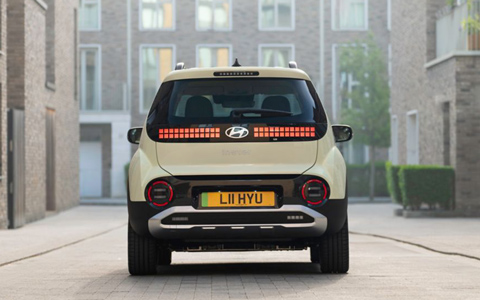
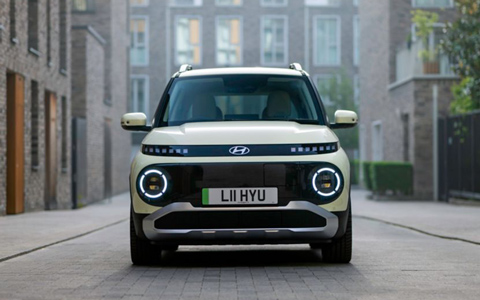
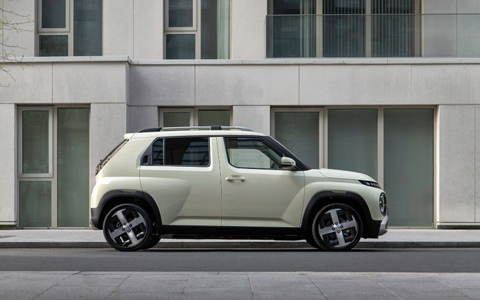
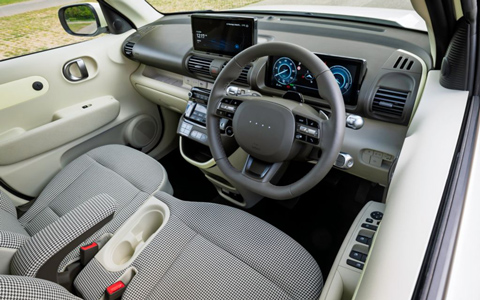
The pixel theme is repeated inside, with graphics on the INSTER’s steering wheel boss. Upper door trim garnish can be customised for owners to further personalise their vehicle.
Both the digital cluster and infotainment touchscreen are 10.25-inches and form part of a compact centre console allowing for an open floor area, great for the kids to clamber in and out if you’ve parked in a tight space or to fit more bags of crap in.
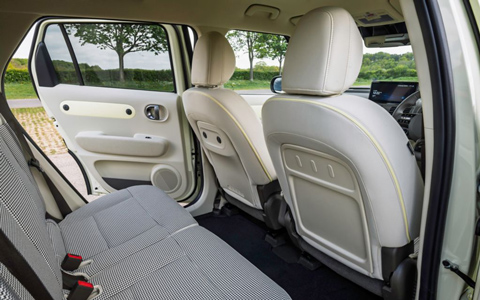
What’s more the passenger seats split 50:50 and fold and if you go for the 02 model like ours the rears can slide and recline and the front seats fold flat which is incredibly useful! The only downside is that the INSTER only seats four, whereas the e-C3, Grande Panda and Renault 5 all seat up to five.
Comfort and practicality
Credit must be given for its Tardis-like cabin. The INSTER offers slightly more headroom in the front and rear than its bigger Kona sibling, with similar legroom in the front and potentially more in the rear with the bench slid back. And slid forward boot space increases from 238 to 351 litres.
If I’m really nit picking, the door pockets are quite narrow, so I couldn’t fit a drink in them, and rear seat passengers miss out on map pockets. Oh and Apple CarPlay and Android Auto are only supported with a lead. And if you’ve had a heated argument with your passenger you’re very close and have to share a rather small armrest!
Below the central touchscreen is a row of actual buttons with shortcuts for radio, media, sat nav, maps, setup and so on, and then there’s a cluster of buttons for adjusting climate control and heated seats.
Both the paint and materials inside utilise sustainable materials ticking the eco-friendly box but doesn’t compromise on quality for the price. Yes there are quite a few scratchy plastics and together with the big chunky buttons it kind of reminds me of cars of the nineties, but it feels well put together and when everything else is so good it didn’t really bother me.

Verdict
They say good things come in small packages – well it couldn’t be truer for this car. It’s funky, fun, easy to drive and live with – I adored it, the kids adored it, and even the grandparents liked it! Yes it’s more expensive than the Renault 5, Dacia Spring, BYD Dolphin Surf, Citroen e-C3 and Leapmotor T03, but if your budget allows, it is a great alternative and I think the tech and flexibility of the 02 version – equipped with the 49kWh long range battery and Tech pack is the best of the bunch for me.
Check out our video review here.

Key Specs
HYUNDAI INSTER 02 49KWH
Price (RRP OTR): From £23,505, £27,505 (model as tested)
Top speed: 93mph
0-62mph: 10.6 seconds
Power: 115PS (113bhp)
Torque: 108lb-ft
Driving range (combined): 229 miles
Charging time: 4.5hrs (11kW, 0-100%), 30 min (120kW, 10-80%)
Insurance group: 21-24
Vehicle warranty: 5 years/unlimited mileage
Battery warranty: 8 years/100,000 miles

1024px.jpg)


Comments (0)
Be the first to write a comment
Login/ Signup