
Reviews 8 min read
Ford Capri review: a legend reborn, or just a badge?
The Capri name returns after 37 years, but as an electric SUV built on Volkswagen underpinnings. Does it deserve the badge, or is it a Ford-flavoured VW with a premium price tag?
Discover EV expert verdict...


3.5 / 5
- Excellent 14.6-inch touchscreen, far better than VW's own systems
- Huge 572-litre boot and plenty of clever storage
- Strong performance and a competitive range of up to 390 miles
- Expensive, and pricier than the closely related VW ID.5
- Light, feedback-free steering and a sometimes crashy ride
- Fiddly haptic steering wheel buttons and frustrating window switches
Overview
"The legend is back," says Ford. But is the new Capri the resurrection of an icon or a brand betrayal?
To answer that, we first need to go back in time. Mechanically based on the Mk2 Ford Cortina, the original Capri went on sale in February 1969 as Europe's answer to the Ford Mustang. Marketed as "the car you always promised yourself", it was offered with a broad range of engines and trims so that as many buyers as possible could afford one. Thanks to a combination of clever marketing, brilliant value and good looks, it was a huge success, selling nearly two million units across three generations.
Fast forward to 2024 and, after a 37-year absence, the Capri has been resurrected, and not without controversy. It's electric only, it's an SUV rather than a coupé, and it's based on the Volkswagen Group's MEB platform, the same underpinnings as the Ford Explorer and VW ID.5 Ford has form here, having revived thePuma, Kuga (albeit with a different spelling) and Mustang names with some success, but fans of the original Capri are far from impressed.
Still, the new car does have a lot going for it. The line-up is made up of two trim levels and three battery options. Select trim is available with RWD or RWD Extended Range, costing £42,075 and £48,075 respectively. Premium trim adds the option of AWD Extended Range, with prices running from £46,175 to £56,175.
Driving
Unlike the original, the new Capri doesn't handle like a sports car, and you certainly don't sit low. Instead, you get the elevated driving position that so many buyers now love.
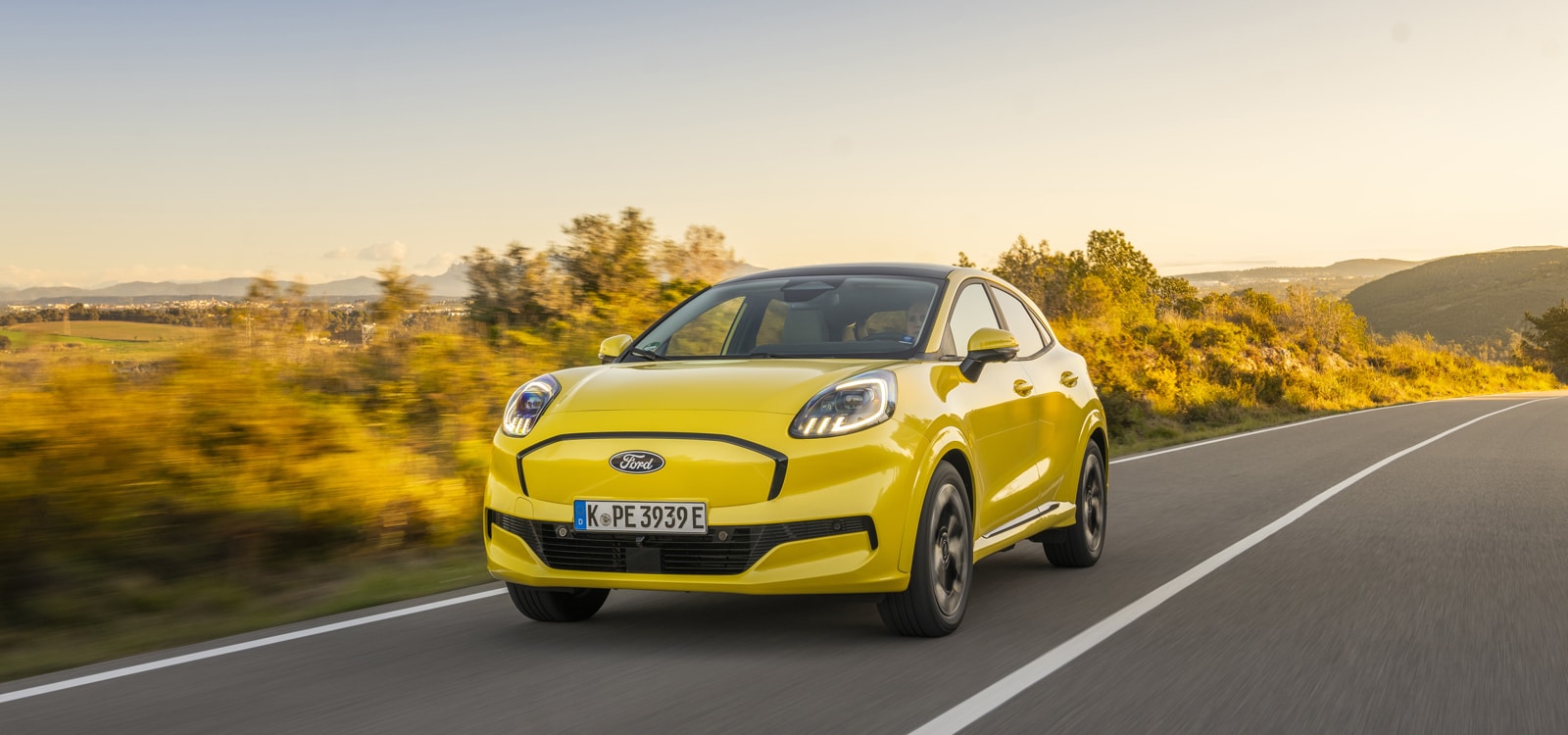
Our test car was the Select RWD Extended Range, which with the £800 yellow paint and £1,800 Driver Assistance Pack will set you back just over £50,000. Blue-collar car this isn't.
The Capri sits 10mm lower than the Explorer, and Ford says it has kept the same levels of comfort while adding a dash of sportiness. It shares plenty of components with the ID.5, but it definitely handles better. The firmer suspension keeps body roll in check, yet the ride often feels crashy over bumps and a little wallowy through dips, especially as speeds rise.
It's grippy and quick in a straight line, and being rear-wheel drive it feels more playful than you might expect. The steering, however, is too light and lacks feedback, which can feel unnerving through corners. It weighs up a little in Sport mode, at least.
There are four drive modes: Range, Normal, Sport and Individual. Ford offers two levels of regenerative braking. The standard 'D' mode is similar to engine braking in a petrol car, while 'B' is more forceful. Neither brings you to a complete stop, and it would be nice to adjust the strength of the regen. The mechanical brakes feel a little spongy too.
The entry-level RWD model produces 168bhp and covers 0-62mph in a respectable 8.7 seconds. The RWD Extended Range's single motor produces 282bhp and 402lb-ft of torque, cutting that time to 6.4 seconds. The AWD Extended Range adds a second motor on the front axle, raising power to 335bhp. Torque stays at 402lb-ft, but the extra traction brings the 0-62mph sprint down to 5.3 seconds.
All in all, it's a bit of a mixed bag, and it lacks that distinctly Ford feel. That's a real shame when you consider how well the Focus and the now-defunct Fiesta handled. Even the Mustang Mach-E is more satisfying to drive.
Range and running costs
The entry-level RWD uses a 52kWh battery and has an official range of 243 miles. The RWD Extended Range gets a bigger 77kWh battery and the longest range in the line-up at 390 miles. The AWD Extended Range has a slightly larger 79kWh battery, but its second motor brings range down to 346 miles.
As ever, real-world range will fall short of these figures. Expect around 300 miles from the RWD Extended Range in mixed driving during milder weather, and noticeably less on cold winter days or at sustained motorway speeds. The standard-range model should manage closer to 190-200 miles.
Frustratingly, a heat pump is optional on every model rather than standard. It's worth adding if you do a lot of winter driving, because it helps preserve range in the cold.
On a public rapid charger, every version can charge from 10-80% in under 30 minutes, which is roughly the current industry norm. The RWD Extended Range tops out at 135kW, while the AWD version can accept up to 185kW. At home, an 11kW wallbox will fully charge the Extended Range models in around eight hours, making an overnight top-up easy.
Design
Visually, the only real similarities between the old and new Capri are the badge and the shape of the rear quarter window. If you're clutching at straws, you could add the large front doors and short rear doors. And if you squint really hard, the wraparound grille with its four "headlamps" is slightly reminiscent of the Mk1. To our eyes, though, the car it most resembles is the Polestar 2. A fastback coupé it isn't, and Philip T. Clark, the American designer who penned the original, would surely be turning in his grave. At least it doesn't look like a rebadged VW ID.4. It's also longer and lower than its Explorer sibling, giving it a sleeker stance.
Inside, the nods to the past are limited to a stylised six o'clock steering wheel spoke and seats with integrated headrests. Otherwise, the cabin is almost identical to the Explorer's, with the small digital driver's display and some of the switchgear lifted straight from the VW ID parts bin. The haptic steering wheel buttons are the worst offenders: they either don't respond or activate by accident. The electric window switches are also frustrating. There are only two, plus a touch-sensitive button to toggle between front and rear windows, as if four proper switches would bankrupt Ford. It's a shame the cabin isn't more retro, but it is modern, well built and pleasant to spend time in.
Comfort and practicality
The highlight of the cabin is the large 14.6-inch touchscreen, which is much better than Volkswagen's offerings. Running Ford's own SYNC software, it's quick to respond and easy to navigate. There's a distinct lack of physical buttons, but shortcuts for frequently used functions stay visible along the bottom of the screen. The screen also tilts by up to 30 degrees, either to reduce glare or bring it slightly closer to you. Behind it sits a hidden storage cubby big enough for your phone, wallet and house keys.
Storage is a real strength. Ford's "MegaConsole" houses vertical slots for wireless phone charging, USB sockets and cupholders, plus a cavernous 17 litres of space under the armrest. Sadly, there's no hidden retro games console to play while you charge. How cool would that have been?
Comfort is good, too. A 12-way electrically adjustable driver's seat with a massage function comes as standard, and there's generous legroom and headroom front and rear.
The boot is a whopping 572 litres, considerably bigger than the Explorer's, and it has a height-adjustable floor. Fold the rear seats and capacity grows to around 1,500 litres, making the Capri a genuinely practical family car.
Verdict
The old and new Capri have virtually nothing in common other than the name, but it's fair to say no other electric SUV has attracted this much attention. In that respect, the marketing has worked. And even though it isn't the sports car Ford might have you believe, the Capri is a likeable car. It's refined, smart, well equipped and spacious, it drives well compared with its rivals, and it has a decent range.
Our biggest issue is price. In 1969, a Capri cost £890, which the Bank of England's inflation calculator puts at around £12,676 in today's money. That comparison is admittedly a little unfair when the UK's cheapest new car, the Dacia Sandero, starts at £14,200. But the point stands: the new Capri doesn't offer the value that made the original so loved. Ford has done a better job with the MEB platform than Volkswagen, producing a car that looks good, is built nicely and drives well, which may be why it costs more than the ID.5. Even so, do you really want to pay more for a Ford-badged VW than Volkswagen charges for its own?
With the Focus scheduled to leave Ford's Saarlouis plant in November 2025, Ford's line-up of affordable, fun-to-drive family cars is shrinking fast. What the Capri doesn't lack is performance. If Ford had also recaptured the sports-coupé styling and affordability that made the original an icon, we'd be far more enthusiastic. It's not a bad EV, but a legend hasn't been reborn either.
Key Specs
Ford Capri (RWD Extended Range tested)
Price (RRP OTR): From £42,075, £48,075 (as tested £50,675)
Top speed: 112mph
0-62mph: 6.4 seconds
Power: 210kW (282bhp)
Torque: 402lb-ft
Driving range (combined): 390 miles
Charging time: approx. 8hrs (11kW, 0-100%), 28 min (135kW, 10-80%)
Insurance group: 33E
Vehicle warranty: 3 years / 60,000 miles
Battery warranty: 8 years / 100,000 miles




Comments (0)
Be the first to write a comment
Login/ Signup